
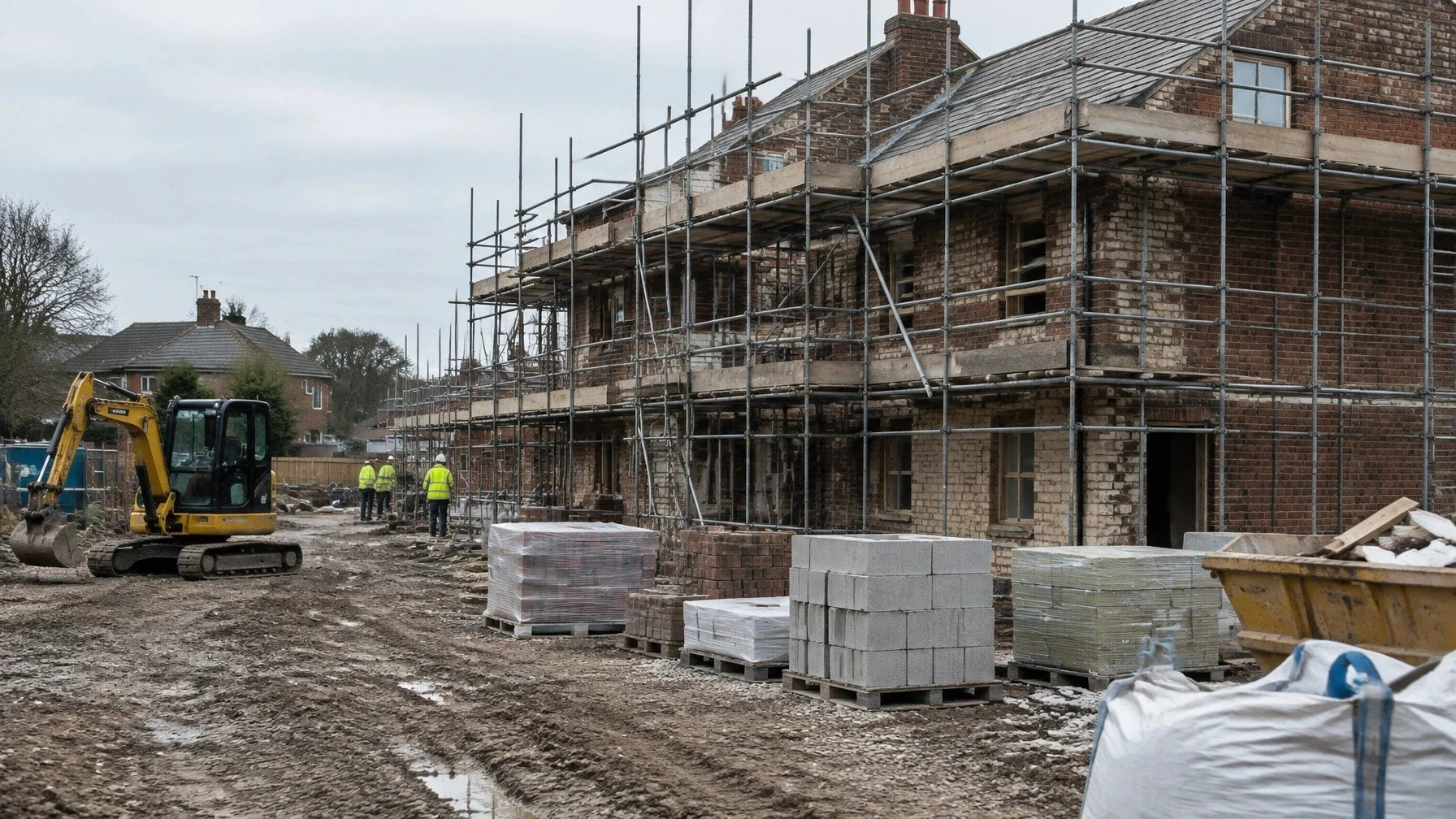
UK construction site with scaffolding and plant equipment, showing the type of project that needs nearby contractor accommodation
Housing a contractor team well comes down to a short list of practical questions: where the site is, how long the work runs, how many people need beds, whether they will share, what the property must include and how the booking can flex if the programme changes. Workforce accommodation is easiest to source, and cheapest to run, when those answers are written down before anyone starts searching. Here are the twelve questions our team asks operations leads before sourcing accommodation for contractors, so you can use the same list on your next project.
Before you start searching
1. Where exactly will the team work, and how will they travel?
Two teams can be based on the same project and need different accommodation, because the journey matters as much as the distance. A property ten miles from site with no parking may be worse than one fifteen miles away with space for vans. Confirm the site address, shift start times and whether the team drives, shares vehicles or relies on public transport.
2. How long is the work expected to run?
A two-week mobilisation and a nine-month package need different booking approaches. Short placements suit flexible weekly bookings; long placements usually justify a different rate and sometimes a company let arrangement. If the programme may extend, say so at the enquiry stage, because the booking terms matter as much as the rate.
3. How many people need beds, and in what layout?
Headcount is only the start. Twelve people could mean twelve single rooms, six twin rooms, three shared houses or one large property. The right layout depends on the team's working pattern, shift times and how well people know each other. Confirm whether couples or pairs share, and whether anyone needs a ground-floor room or other specific requirement.
4. Does the team stay together or split across sites?
If a project covers several locations, decide early whether accommodation sits at each site or at one central base. A single base is often cheaper and simpler to manage, but travel time eats into shifts. Splitting the team across two properties close to each site can work out better overall, even at a slightly higher nightly rate.

Two colleagues reviewing an accommodation checklist at a table with a laptop, planning workforce accommodation for a project
What the property actually needs
5. What must be included, not just available?
A kitchen, laundry facilities, Wi-Fi and parking are the usual requirements for contractor teams, but confirm them explicitly. If the team uses vans, parking is not a nice-to-have. If shifts start early, reliable heating and hot water matter more than a large living room. Write the non-negotiables into the enquiry so quotes can be compared fairly.
6. When do people arrive and leave, and who handles check-in?
Site teams often arrive at unusual hours, and some properties have fixed check-in windows or self-service access. Confirm how keys or access codes are issued, whether arrivals outside office hours are supported and what happens if a member of the team arrives a day late. These details cause more problems on day one than the rate ever does.
7. How will issues be reported during the stay?
A broken boiler on a Wednesday night needs a named contact, not an email address checked once a day. Ask how maintenance requests are handled, what the response commitment is and who in your own team owns the relationship. With managed corporate accommodation, Silverlake Group provides a single point of contact for the length of the stay, which removes the need for your team to chase individual landlords or platforms.
8. What happens if the team size changes?
Contractors move on, agencies swap personnel and programmes shift. Check whether the booking can be reduced or extended, what notice is required and whether the rate holds. A booking that cannot flex becomes expensive the first time the programme changes.
Cost, terms and the stay itself
9. What is the full cost, not just the nightly rate?
Compare quotes on total cost: accommodation, cleaning, bills, parking, deposits and the journey to site. A lower nightly rate with separate cleaning charges and no parking can cost more over a month than a fixed weekly rate that includes everything. Ask for an itemised quote covering the expected dates, including the terms for extension.
10. Who approves and pays, and how does invoicing work?
Finance teams often prefer one invoice per property per month rather than dozens of individual bookings. Confirm whether the provider can invoice the company directly, whether deposits are required and how cancellations are charged. If several projects will need accommodation over the year, a managed account with consistent terms saves administrative time on every booking.
11. What standard should the team reasonably expect?
Contractor accommodation does not need to be luxurious, but it does need to be clean, safe and genuinely liveable. Check recent photographs, confirm the property is professionally managed and read how the provider handles problems. The cheapest option that leaves people tired and unsettled usually costs more in the long run than a slightly higher rate for a property the team is happy to return to.
12. Who is accountable if something goes wrong?
With self-booking platforms, accountability sits with whoever booked. With a managed provider, it sits with the provider. Decide which model suits your project. If your operations team is already stretched, having one accountable partner who sources, manages and resolves issues across every location is usually the simpler structure.
Making the right call
Answer these twelve questions in writing before you request quotes, and you will get faster responses, fairer comparisons and far fewer surprises once the team arrives. If you would rather not run the process yourself, send Silverlake Group your project details and we will source and manage accommodation for your contractor team across the UK and Ireland.
Frequently asked questions
What is workforce accommodation?
Workforce accommodation is accommodation arranged for a team working away from home, usually near a project site and booked for the length of the work. It ranges from individual rooms to whole shared properties.
How far from site should contractor accommodation be?
It depends on shift patterns and transport. As a practical test, the journey should be short and predictable enough that people arrive rested and on time, with parking confirmed if the team drives.
Can accommodation be extended if the project overruns?
Often, yes, but terms vary. Ask at booking stage how extensions work, what notice is needed and whether the rate holds for the additional period.